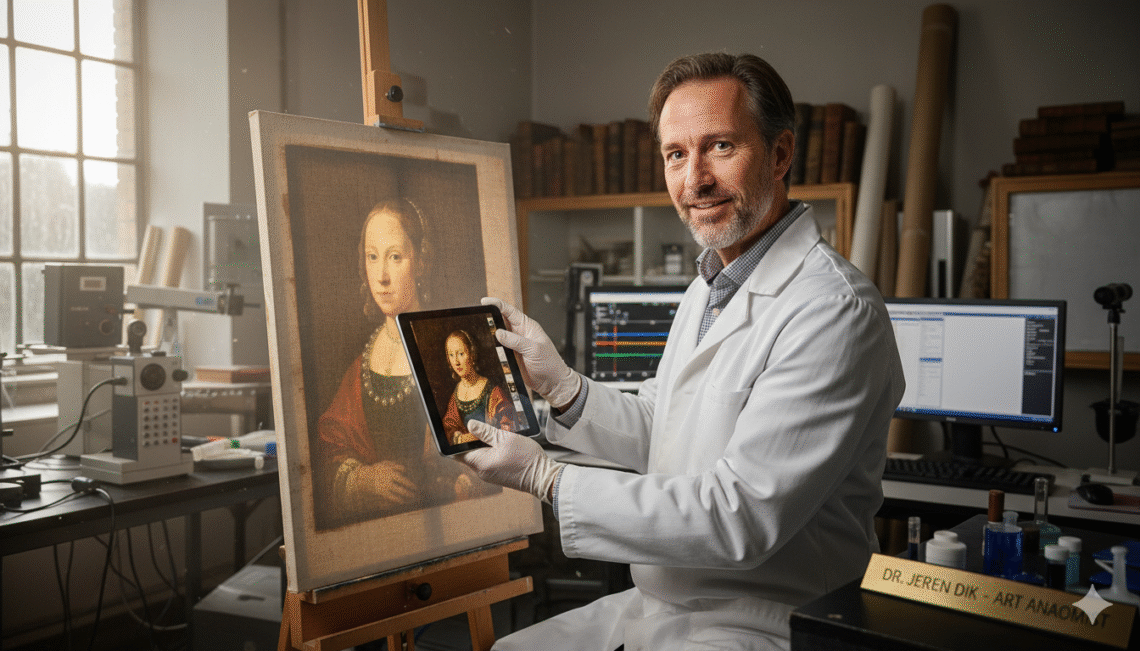
Have you ever looked at a famous painting and wondered if there was a secret hidden right beneath the surface? For most of us, a painting is just what we see on the canvas. But for Jeroen Dik, a brilliant professor and researcher, a painting is like a time capsule with many layers. Jeroen Dik doesn’t just look at art; he looks through it. By using powerful science tools, he helps us see things that have been hidden for hundreds of years. It’s like having X-ray vision for history!
In this article, we will explore the amazing work of Jeroen Dik. We will learn how he uses technology to find “lost” paintings and why his work is so important for museums and art lovers everywhere. If you love mysteries and cool science, you are in the right place. Let’s dive into the story of the man who makes the invisible visible.
Key Highlights of Jeroen Dik’s Career
| Feature | Details |
| Primary Role | Professor of Materials Science in Art & Archaeology |
| Institution | Delft University of Technology (TU Delft) |
| Key Technology | X-ray Fluorescence (XRF) & Synchrotron Radiation |
| Famous Discovery | Hidden portrait under Van Gogh’s “Patch of Grass” |
| Focus Areas | Art History, Chemistry, and Forensic Science |
| Award & Grants | NWO Grants and Member of the Young Academy (KNAW) |
Who is Jeroen Dik?
Jeroen Dik (often referred to in academic circles as Joris Dik) is a world-renowned scientist based in the Netherlands. He works at the Delft University of Technology, where he leads a group of researchers who study old objects. While most scientists might study rocks or engines, Jeroen Dik focuses on paintings, sculptures, and archaeological finds. He grew up in a family of art restorers, so he has always had a deep love for the beauty of the past.
Instead of using a paintbrush, Jeroen Dik uses high-tech scanners. He bridges the gap between the world of art and the world of chemistry. His goal is to understand how artists made their work and how we can protect those works for the future. By understanding the chemical “DNA” of a painting, he can tell if it’s a real masterpiece or a clever fake.
The Science of Seeing Through Paint
How can someone see through layers of thick oil paint? Jeroen Dik uses a technique called X-ray Fluorescence (XRF). Imagine shining a special light on a painting. When this light hits the different minerals in the paint, the minerals “glow” back in a way that only a computer can see. Each color has its own signature. Lead white looks different from cinnabar red under the scanner.
By mapping these signals, Jeroen Dik can recreate a picture of what is hidden underneath. Many famous artists, like Vincent van Gogh, were often poor and would reuse their canvases. They would paint a new picture right on top of an old one! Thanks to the work of Jeroen Dik, we can now see these abandoned sketches and “lost” portraits without ever touching the original surface.
Discovering the Hidden Van Gogh
One of the most exciting moments in the career of Jeroen Dik happened in 2008. He worked on a painting by Van Gogh called “Patch of Grass.” For a long time, experts suspected there was something else under the green grass. Using a massive particle accelerator (a machine that creates very bright light), Jeroen Dik scanned the canvas.
The results were stunning. Beneath the grass was a detailed portrait of a woman! This “hidden lady” hadn’t been seen in over a century. This discovery made headlines all over the world. It proved that Jeroen Dik and his team could literally “dig” through history using science. It gave us a new look into Van Gogh’s early life and how his style changed over time.
Why Materials Science Matters in Art
You might ask, “Why do we need a chemist to look at a painting?” The answer is simple: paintings are physical objects that change over time. Jeroen Dik uses materials science to see how paint cracks, fades, or reacts to light. This is very important for art conservation. If we know exactly what chemicals are in a painting, we can figure out the best way to keep it from falling apart.
Furthermore, Jeroen Dik applies this knowledge to forensic science. Sometimes, people try to sell fake paintings for millions of dollars. By using his scanners, Jeroen Dik can check if the pigments used in a painting actually existed during the artist’s lifetime. If a “Rembrandt” contains a type of blue paint invented in 1950, he knows something is wrong!
The Role of TU Delft in Art Research
The Delft University of Technology is a hub for innovation, and Jeroen Dik is at the heart of it. At TU Delft, his department combines engineering with history. They even use 3D printing to recreate the texture of famous paintings. This allows people to touch a “copy” that feels exactly like the original, including the bumps of the brushstrokes.
Under the leadership of Jeroen Dik, the university has become a world leader in “technical art history.” This means they don’t just talk about the meaning of a painting; they prove its history through data. This scientific approach has changed how museums like the Rijksmuseum and the Kröller-Müller Museum care for their collections.
Working with Particle Accelerators
Most people think of particle accelerators like the one at CERN as tools for finding tiny atoms. However, Jeroen Dik uses them for art. He often takes paintings to places like the ESRF (European Synchrotron Radiation Facility). These giant machines produce X-rays that are millions of times brighter than the ones in a doctor’s office.
This intense light allows Jeroen Dik to see through many layers of paint very quickly. It provides a “3D map” of the chemical elements in the artwork. While it sounds like science fiction, it is a very real part of how we study history today. Jeroen Dik is one of the few people who can navigate both the sterile world of a lab and the dusty halls of an art gallery.
Jeroen Dik and “The Secret of the Master”
If you live in the Netherlands, you might recognize Jeroen Dik from the popular TV show “Het Geheim van de Meester” (The Secret of the Master). In this show, a team of experts tries to recreate famous paintings exactly as they were made. Jeroen Dik provides the scientific “detective work.”
He analyzes the original painting to find the exact chemical recipes for the colors. This helps the team’s painter use the same materials that the old masters used. This show has made the work of Jeroen Dik famous among the general public. It proves that science isn’t just for textbooks—it can be fun, creative, and very beautiful to watch.
Protecting Modern Art for the Future
While much of his work is on old masters like Rembrandt, Jeroen Dik is also worried about modern art. In his TEDxTalk, he discussed how many modern materials, like plastics and certain dyes, don’t last very long. They can melt or change color very fast.
Jeroen Dik argues that we need to use technology now to document these works before they disappear. His “people-first” approach means he wants future generations to enjoy the art of today just as much as we enjoy the art of the past. He is a true guardian of human creativity, using his expertise to ensure that beauty doesn’t fade away.
The Future of Art Scanning Technology
What is next for Jeroen Dik? He is currently working on making scanners smaller and more “mobile.” Right now, many paintings have to be moved to a lab, which is risky and expensive. Jeroen Dik wants to bring the lab to the museum.
By creating portable X-ray fluorescence devices, he can help museums all over the world scan their basements for hidden treasures. There are likely thousands of hidden paintings waiting to be found. With the vision and dedication of Jeroen Dik, we are entering a new “Golden Age” of discovery where every canvas has the potential to tell a brand-new story.
Conclusion: A Legacy of Discovery
In the end, Jeroen Dik is much more than just a scientist or an art historian. He is a bridge-builder. He shows us that when we combine different ways of thinking—like chemistry and art—we can solve mysteries that seemed impossible. His work reminds us that there is always more to a story than what we see on the surface.
Because of Jeroen Dik, we have a deeper understanding of geniuses like Van Gogh. We have better tools to catch forgers and better ways to save old masterpieces from the ravages of time. He has truly turned the world of art into a giant, beautiful laboratory.
Frequently Asked Questions (FAQs)
1. Who exactly is Jeroen Dik?
He is a professor at Delft University of Technology who specializes in using materials science to study and preserve famous works of art.
2. What is Jeroen Dik’s most famous discovery?
He is best known for discovering a hidden portrait of a woman beneath Vincent van Gogh’s painting, “Patch of Grass,” using X-ray technology.
3. How does Jeroen Dik see through paintings?
He uses a technique called X-ray Fluorescence (XRF). This method maps the chemical elements in different paint layers to reveal what is hidden underneath.
4. Why is Jeroen Dik’s work important for museums?
His research helps museums identify fakes, understand how to clean old paintings safely, and discover hidden histories within their collections.
5. Does Jeroen Dik work with other artists besides Van Gogh?
Yes! He has worked on masterpieces by Rembrandt, Vermeer, and even modern artists, helping to protect and analyze a wide variety of cultural heritage.